►►­­LY◄◄ || ►►­­NP◄◄

Sep 2, 2001

Blog (Weblog) - GujaratiKanudo

A blog (short for weblog) is a personal online journal that is frequently updated and intended for general public consumption. Blogs are defined by their format: a series of entries posted to a single page in reverse-chronological order.Blogs generally represent the personality of the author or reflect the purpose of the Web site that hosts the blog. Topics sometimes include brief philosophical musings, commentary on Internet and other social issues, and links to other sites the author favors, especially those that support a point being made on a post.

The author of a blog is often referred to as a blogger. Many blogs syndicate their content to subscribers using RSS, a popular content distribution tool.
For more information, see weblog.

-MEHUL PATEL

Aug 25, 2001

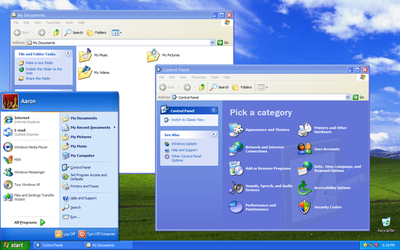
Microsoft Windows XP Found

Today !!
24 August 2001
Microsoft Found and Release "Microsoft Windows XP" First Edition !!

Congratulations to All Windows OS Users..


Experience the best and new Windows XP..


Jan 10, 2001

Multitasking

Multitasking, in an operating system, is allowing a user to perform more than one computer task (such as the operation of an application program) at a time. The operating system is able to keep track of where you are in these tasks and go from one to the other without losing information.

Microsoft Windows 2000, IBM's OS/390, and Linux are examples of operating systems that can do multitasking (almost all of today's operating systems can). When you open your Web browser and then open Word at the same time, you are causing the operating system to do multitasking.

Being able to do multitasking doesn't mean that an unlimited number of tasks can be juggled at the same time. Each task consumes system storage and other resources. As more tasks are started, the system may slow down or begin to run out of shared storage.

It is easy to confuse multitasking with multithreading, a somewhat different idea.

-MEHUL PATEL

May 10, 2000

Microsoft Certified Systems Engineer (MCSE)

An MCSE (Microsoft Certified Systems Engineer) is someone who has passed exams about the Microsoft Windows NT operating system, related desktop systems, networking, and Microsoft's BackOffice server products. To prepare for the exams, you can take courses at a certified training company location, in certified courses in a high school or college, or through self-study at Microsoft's self-study Web site or through certified training materials.


The MCSE program is the most popular of a set of training programs that Microsoft calls the Microsoft Certified Professional (MCP). In other MCP programs, you can gain certification as a Microsoft Certified Solution Developer (MCSD), a Microsoft Certified Product Specialist (MCPS), or a Microsoft Certified Trainer (MCT).

-MEHUL PATEL

Jan 1, 1998

Windows NT - GujaratiKanudo

Windows NT is a Microsoft Windows personal computer operatingsystem designed for users and businesses needing advanced capability. NT's technology is the base for the Microsoft successor operating system, Windows 2000. Windows NT (which may originally have stood for "New Technology," although Microsoft doesn't say) is actually two products: Microsoft NT Workstation and Microsoft NT Server. The Workstation is designed for users, especially business users, who need faster performance and a system a little more fail-safe than Windows 95 and Windows 98. The Server is designed for business machines that need to provide services for network-attached computers. The Server is required, together with an Internet server such as Microsoft's Internet Information Server (IIS), for a Windows system that plans to serve Web pages.

Windows NT Workstation: Microsoft says that 32-bit applications run 20% faster on this system than on Windows 95 (assuming both have 32 megabytes of RAM). Since older 16-bit applications run in a separate address space, one can crash without crashing other applications or the operating system. Security and management features not available on Windows 95 are provided. The Workstation has the same desktop user interface as Windows 95.

Windows NT Server: The NT Server is probably the second most installed network server operating system after Novell's NetWare operating system. Microsoft claims that its NT servers are beginning to replace both NetWare and the various UNIX-based systems such as those of Sun Microsystems and Hewlett-Packard. NT Server 5.0. essentially became what was renamed Windows 2000.

Notable features of the Windows 2000 products are:
  • A fully-customizable administrative console that can be based on tasks rather than files, applications, or users
  • A new file directory approach called Active Directory that lets the administrator and other users view every file and application in the network from a single point-of-view.
  • Dynamic Domain Name Server (DNS), which replicates changes in the network using the Active Directory Services, the Dynamic Host Configuration Protocol (DHCP), and the Windows Internet Naming Service (WINS) whenever a client is reconfigured.
  • The ability to create, extend, or mirror a disk volume without having to shut down the system and to back up data to a variety of magnetic and optical storage media.
  • A Distributed File System (DFS) that lets users see a distributed set of files in a single file structure across departments, divisions, or an entire enterprise.
  • Close integration with and support for Microsoft's Message Queue Server, Microsoft Transaction Server, and Internet Information Server (IIS).
-MEHUL PATEL